• Top Ten Nutritional Mistakes
  • E-Book
  • Reviews
  • Lectures/Workshops
  • Primal Blog
  • Contact
  • Nora Gedgaudas

    Here it is…June already…and I am fast approaching yet another semi-milestone along the path of my existence:  It just so happens I turn 49 years of age this Thursday, June 10th.  I’ll be “pushin’ 50”.

    A lot of folks (women, in particular, I think) would be freaking out about this, maybe “feeling old”, maybe counting the aches and pains or gray hairs and wondering what other downturn was next.  For me, though, it’s just another birthday (though I really like birthdays) along the way and a time in which I am celebrating excellent health and vitality.

    Some of you might be thinking “well, she’s probably got good genetics and was just blessed with good health.”

    Not so.  My genetics actually suck.

    My family tree is riddled throughout with health issues on every level—including issues with cancer, cardiovascular disease, arthritis and autoimmune illness, along with weight issues and various other assorted brain, nervous system and emotionally related challenges.  In the past I have struggled with weight, eating disorders, long-term depression, anxiety and panic attacks.  Those are all very much things of the past.  More recently, various stress-related challenges have really rocked my equilibrium and have tested what I have learned in no small way.  Thus far, I’m happy to say I’ve managed to dodge the other bullets and am the only member of my family that has managed to never spend a single night at a hospital for anything.  I can tell you, though, that “luck” and “great genes” have nothing to do with the health I enjoy today.  I have worked hard at this…and I’ve learned that I really don’t have that much room for error.

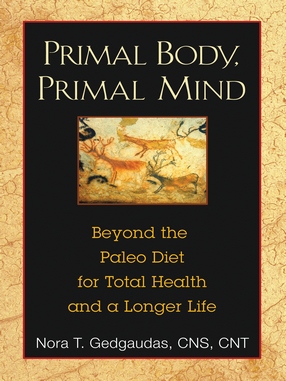
    I have been passionate about diet and health for 30 years now, though I would have given anything to know what it is I know now even 20 years ago.  I’ve been led down a lot of different paths.  It has literally taken me most of this time to sort out the convoluted quagmire that is the current realm of nutritional information and nutritional dis-information to arrive at what it is you read in Primal Body-Primal Mind.   I continue to learn and reach for answers that underlie the supposed answers and will forever continue to do so.  I have looked both inside and outside “the box” of accepted dogma to arrive at a coherent picture that makes foundational sense and (more importantly) really works.  I’ve learned, too, that the answers are seldom where one would expect to find them and that economic and political interests are there to seduce and trip you up every step of the way.  There is no university program that teaches it in full.  There isn’t even a single university course available as yet in the field of Functional Medicine.  The field is THAT new.  Accurate foundational nutrition or health education is never taught in a conventional setting.  There are simply too many vested interests influencing and distorting such curriculums.

    It’s been a journey for me of peeling away layers of an onion to get at the principles I’ve uncovered that can make becoming healthy—and remaining healthy into even old age a very plausible reality for most anyone that is willing to apply this foundational and functional approach to well being.  Sometimes the answers were so obvious they were difficult at first to see (such as the evolutionary basis for establishing our nutritional requirements…DUH!) and sometimes it took the willingness and self-discipline to relinquish the temptation to reach for simple “single note” answers and be willing to take into account the complex orchestration of the human organism and all its dimensions; and a more systems-related and functional approach to unraveling the truth.  It’s a more difficult and less seductive pathway to take, but one that yields far more genuine rewards.  It takes de-compartmentalizing the body and mind to get that it’s all part of a functional network that can’t be separated out or fully understood inside a limited box.  Things are rarely as literal as they seem and you seldom can fix one system by viewing it as something that stands alone.  In other words (just for instance), if your thyroid is functioning low it is probably not as simple as adding more thyroid hormone or just thyroid “accessory nutrients” to fix the problem, even though this is the “gold standard” approach in conventional and even most natural medicine.  There are other endocrine networks to take into account, possible immune challenges, environmental factors, food sensitivities and basic nutritional requirements that all factor into the total picture.  That’s what’s called the “functional” picture.  This is the paradigm I come to you from…and I’m sticking to it.

    So….here I am in my last days of being 48 years of age, still feeling fully functional and even feeling “younger” in some ways than I felt even a year or two ago.  I’m still on the path to figuring out the mysteries of longevity and optimal health and wellness…and as long as there’s someone who wants to hear about it I’ll be around…hopefully for a very long while…to share what I’ve learned with all of you.

    This is, after all, what I believe I was born to do.

    ~ Nora

    Q: I have a health question about my school-girlfriend in Germany.

    She’s got something happening in her legs which make walking kind of shaky and unsafe. She always needs to use a walking stick outside now. She was in the hospital for 5 days doing all kinds of tests. All blood tests came out OK.

    They call it POLYNEUROPATHY and have no explanation for it. It’s supposedly age-related.

    The pain gets a little better or less when taking Vitamin B6 and B12.

    Do you know more about it? She and her husband are not particularly skinny and don’t eat a very healthy diet.

    A: Any neuropathy is basically a state of advanced glycation—where sugars in the bloodstream combine with fats and proteins throughout the body–but especially in the nerve fibers and cause them to become sticky, misshapen and malfunction.  Nerve and brain tissue are especially vulnerable to glycation because they cannot become insulin resistant.  Some glycation may be reversed but much of it can’t.  It is basically the primary mechanism of aging and what eventually does us in.  A nerve damaged by glycation is also much more vulnerable to other free radical and antigenic (allergy-related) influences and damage.

    My recommendation to her would be to undertake a complete avoidance of ALL sugar and starch (even fruit) and start a regimen of anti-glycating nutrients such as L-carnosine, R-lipoic acid, acetyl l-carnitine, benfotiamine and pyridoxamine.  That’s what I would do.  She will need to be very disciplined if she hopes to improve her condition.  B6, B12, folic acid and other methyl donors (and B-complex in general) are always helpful to the brain and nervous tissue and help to minimize the toxic effects of homocysteine, but they are not directly anti-glycating, except for B6 (in its P-5-P form).  I agree they are also a very good idea, however.  For B12 she should be taking it sublingually and in a form called “methylcobalamin”.  Methyl donors (along with phospholipids, fats, cholesterol and other B vitamins) are essential to the integrity of the myelin sheath—the protective insulating layer covering nerves.  B12 deficiencies are common in old age because digestion, hydrochloric acid and intrinsic factor tend to be diminished.   There is no question that B12 deficiency can be a contributing factor here.  You need ample methyl donors for healthy nerves.  B6 (P-5-P) is an important anti-glycating nutrient, especially in its fat soluble form, called “pyridoxamine”.  Essential fatty acids (omega-3’s and GLA) and vitamin D are also important.

    I would also HIGHLY recommend a very strict gluten free diet.  There is NO question that gluten and gliadin (from grains) can have a devastating impact on the nervous system.  In fact, it can be THE primary manifestation of celiac disease for many!  This is very commonly overlooked by most doctors and she will have to do some homework to find a specialist knowledgeable about these issues.  It might be very worthwhile for your friend to explore the possibility of celiac disease.  Here in the States we have a very innovative lab, called “EnteroLab”, offering the most accurate testing for gluten sensitivity and the genetic markers that predispose to that (www.enterolab.com).  Gluten sensitivity and celiac disease are essentially identical in effect and health impact.  What distinguishes them from one another is a fine gray line of “genetic” manifestation.  Genetic manifestation is not essential for celiac disease effects to occur, however, and diagnostic methods have traditionally been somewhat unreliable.  False negatives are VERY common.  Doing a salivary or blood test and having the result show as “negative” does NOT necessarily mean you don’t have the problem.  If it shows “positive” in any way, shape or form you can take that to the bank—but negatives tell you ultimately very little, unfortunately.  My perspective says to go by symptoms.  ANY symptoms affecting gastrointestinal issues, nervous system or brain issues, mood, memory, cognitive functioning, inflammation, autoimmune issues or almost anything tell me that gluten sensitivity is a very real possibility, if not an overwhelming likelihood.  I tend to just want to assume it in those cases and proceed accordingly…but many people need to see the proof in a lab test.  It can take a variety of diagnostic methods to get at the truth.  The gold standard is really an “elimination diet” where gluten-containing foods are simply removed from the diet and one is left to observe whether symptoms improve in time.  I’m not sure what she has available there in Germany but intestinal biopsy as a “classical” diagnostic method can miss 7 out of 10 cases.  The next best thing would be to test for IgA, IgG and IgM, gluten, gliadin antibodies and transglutaminase in the blood.  If they have the means to test for the genetic markers for celiac disease, so much the better.  Avoidance of gluten for the susceptible goes well beyond avoiding grains, though.  It is in virtually ALL processed foods unless otherwise specifically labeled “gluten free”.  Those vulnerable to gluten (and I would put money on this with your friend) need also to avoid gluten present even in shampoos, lotions and cosmetics (often listed as “wheat protein” or “hydrolyzed protein”).  Even one crumb of gluten in a month or the tiniest bit absorbed by the skin into the system can set up an inflammatory response that can last for up to 6-8 months and have devastating consequences! Gluten sensitivity is THAT serious.  Abstinence has to be 100% ALL of the time.  NO exceptions.  Casein sensitivity (milk protein) is a distinct possibility, also, and should always be suspected where gluten issues are present.  Gluten sensitivity and celiac disease are currently epidemic.

    The diet of choice here is a sugar and starch-free, gluten-free (and probably casein-free) diet with a moderate amount of complete (animal/seafood source) protein and enough quality natural fats to satisfy appetite and also meet critical essential fatty acid and fat soluble nutrient needs.  Dietary fat and cholesterol become VERY important where nerve health is concerned.

    We all love our indulgences and feel they are harmless–or maybe even think they are somehow good for us–until they begin to exert their cumulative toll and things start breaking down.  What is happening to your friend didn’t happen “all of a sudden” but is the result of a certain way of eating and lifestyle over many, many years—even a lifetime.  Eventually it catches up with you.  That is what got her into the state she’s in and she’ll need to address similar mechanisms if she wants to get out of it.  She has no more room for indulgences.

    Neuropathy isn’t a “normal variant of aging”.  It is nerve damage brought on (in simple terms) by a lifetime of sugar and starch consumption.  No drug will fix it.

    I hope she is able to find some improvement and relief from her condition!

    ~ Nora

    noracrop

    Disclaimer:

    The ideas and suggestions written by Nora Gedgaudas in this website are provided as general educational information only and should not be construed as medical advice or care. All matters regarding your health require supervision by a personal physician or other appropriate health professional familiar with your current health status. Always consult your qualified personal health care provider before making any dietary or exercise changes. Nora Gedgaudas and Northwest Neurofeedback, Inc. disclaims any liability or warranties of any kind arising directly or indirectly from use of this website. If any medical problems develop, always consult your qualified personal health care provider. Only your physician can provide you medical advice.